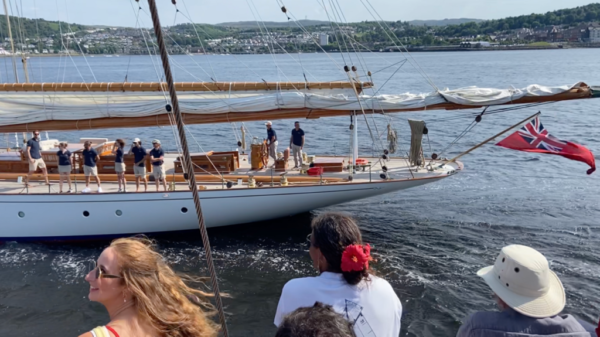
The “small” gaff cutter Thalia has over the last 10 days taken major scalps in the Richard Mille Cup, a series of 8 races sailed on the Clyde out of Largs.
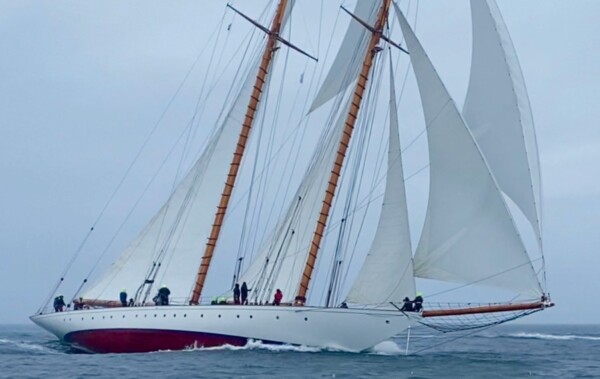
Overall, with an entirely Corinthian ladies and gentlemen scratch crew, she beat both of the great >100’ Fife gaff cutters Moonbeam and Moonbeam IV and was only a few places behind Mariquita, the 125’ Goddess of the Fifes.
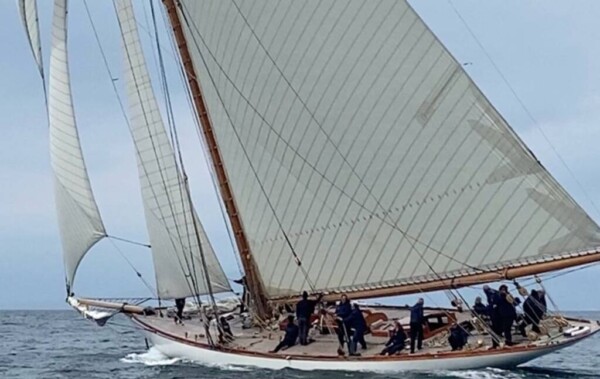
On several occasions Thalia pluckily luffed the wonderful schooners Elena, a copy of Westwood, and Atlantic, a copy of the Atlantic record holder of the same name, forcing both to go past at immense speed under the lee rail.
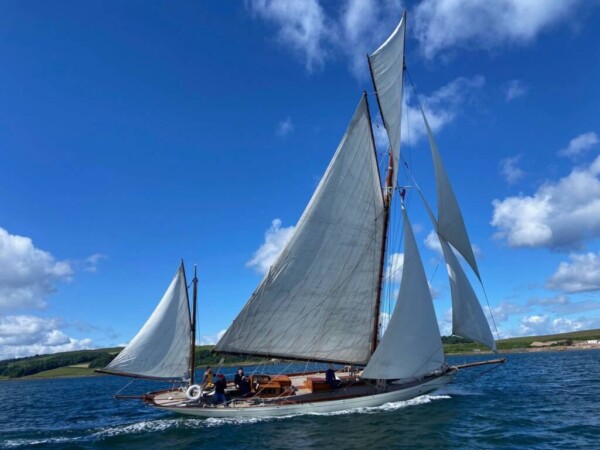
Thalia, the oldest yacht in the regatta, was built by George Wanhill in 1888. Thalia has LOD 45’ and a 17’ bowsprit. Maximum sail set upwind, aft to fore, is main, main top, staysail, working jib and flying jib. Downwind, the flying jib can be replaced with a much larger balloon jib.
There is not a single winch aboard! Virtually all ropes are light brown.
The main sheet has a 6:1 handy billy yet can require sweating by three crew. The running backstays have a fixed (yet moveable) end linked by a 2:1 yoke to a fast end with a 4:1 handy billy, leading to a further to a 4:1 handy billy, making a total gear ratio of 32:1 for the final tweaking. The staysail has a 2:1 sheet and the lazy sheet is used for barber haul adjustment. The working jib has no gearing at all and can require 2 burly crew. The flying jib has a fast 1:1 tail and a 6:1 handy billy can be attached to a loop in it for the final haul in. The balloon jib has no gearing at all and even in a Force 2 can require 3 crew to pull it in.
There were two very tough days of sailing in blustery rain and six days of glorious sunny racing round Big Cumbrae, Wee Cumbrae, Bute and Inchmarnock, many of the courses being set at least partly within the wide Firth between Largs and Rothesay.
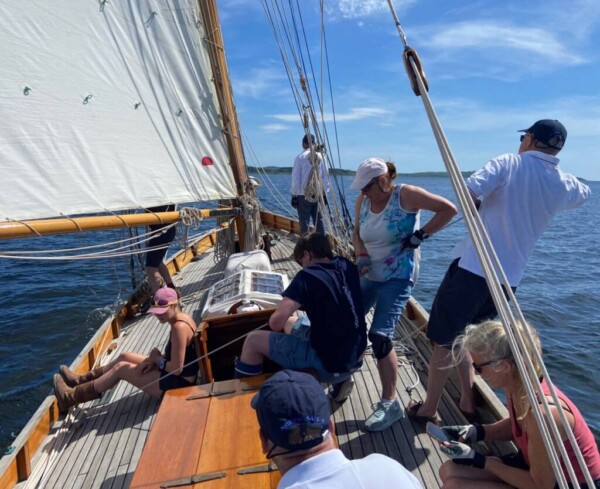
Thalia was closely matched to Patna, the Helford-based gaff yawl, with Patna generally slightly faster upwind but Thalia having the edge downwind while using the balloon jib.
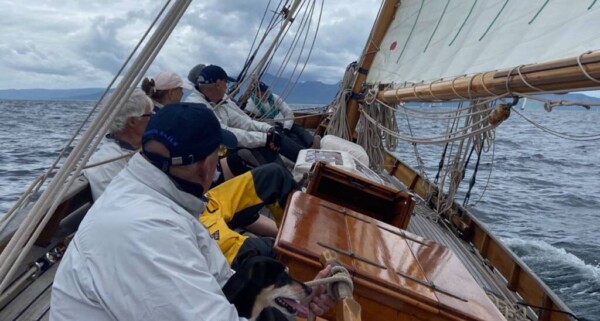
Thalia outwitted many entirely pro crews on occasion, largely by using the local knowledge of three of the Clyde’s finest International-6 and other helms who were aboard. She also carried further fabulous local Scots sailors including a sailmaker, a chandler, a pilot, two keen yacht club volunteers and a Rear Admiral of the famous Mudhook. Thalia’s crew was typically 8 selected from:
David
Norman, Martin & Sam
Brian and Norman
Eva, Ronnie, Val, Chloe & Fraser
Ian, Fiona & Colin
Pete
Jim
Ayla, the Jack Russell
Bow & Skipper
Halyards (x8), Topping Lifts, Furler and Staysail
Midshipmen
Working Jib & Balloon Jib
Running Backstays & Flying Jib
Driver
Main Sheet & Navigator-Tactician
The Hounds & Officer of the Dog Watches
After the regatta, the crews were taken out for the day on the PS Waverley for a cruise to Greenock Custom House from Largs Pier via Loch Long and Loch Goil. There was a fine hooting match as Elena and Atlantic formed up either side of Waverley and Elena saluted with her winch cannons!
For the engineers, Waverley steams at Full Steam Ahead at boiler pressure 160 psi (cf Flying Scotsman LNER 220 psi, Merchant Navy class SR 280/250 psi) with the pressure after the first expansion at 120 psi, after the second at about 50 psi and atmospheric after the big third cylinder. When she throttles back to Slow Ahead to crawl past the RN nuclear weapons dump on Loch Long with minimum wake, the boiler pressure initially goes up to 175 psi but the lower pressures fall much lower.